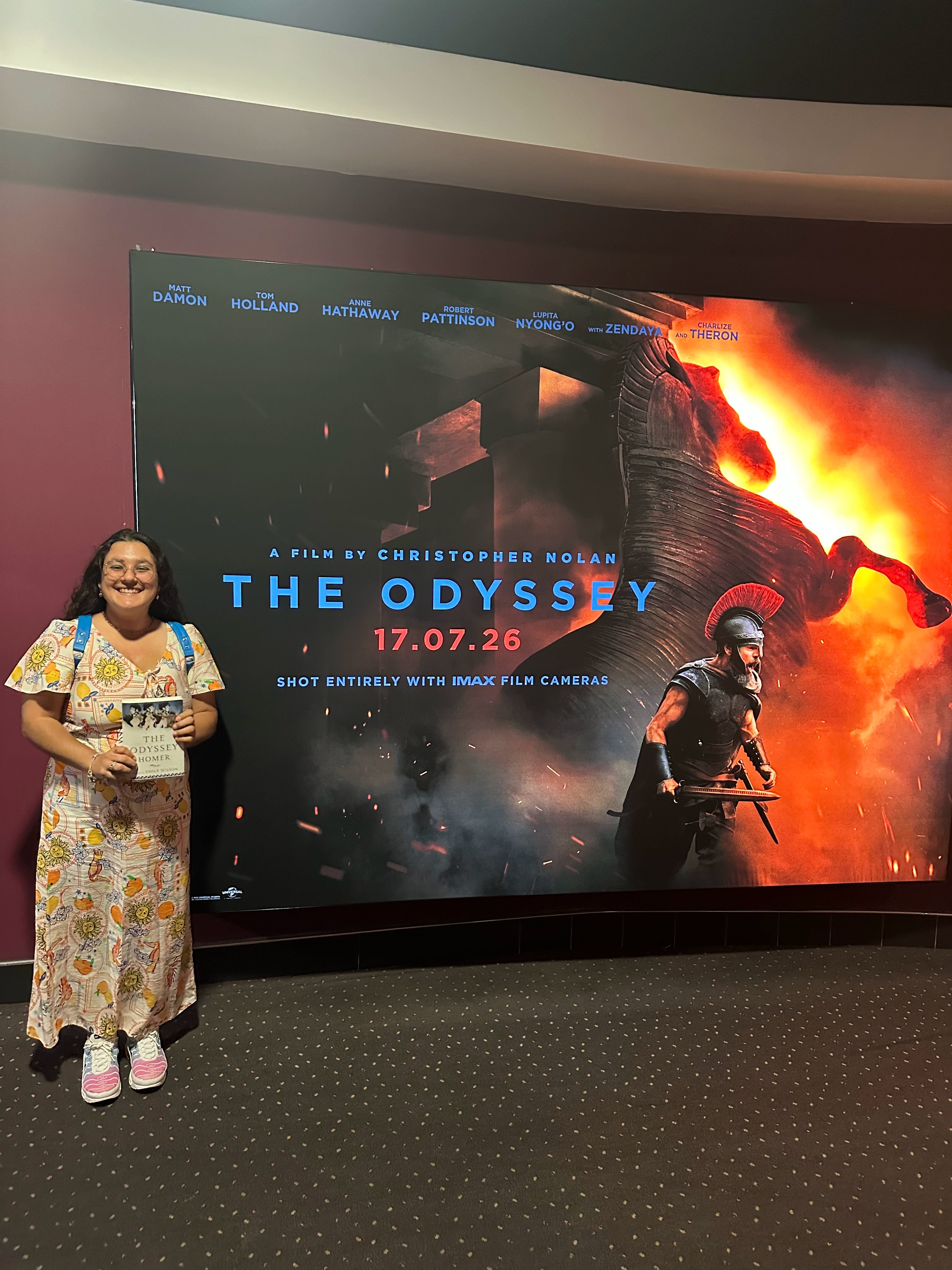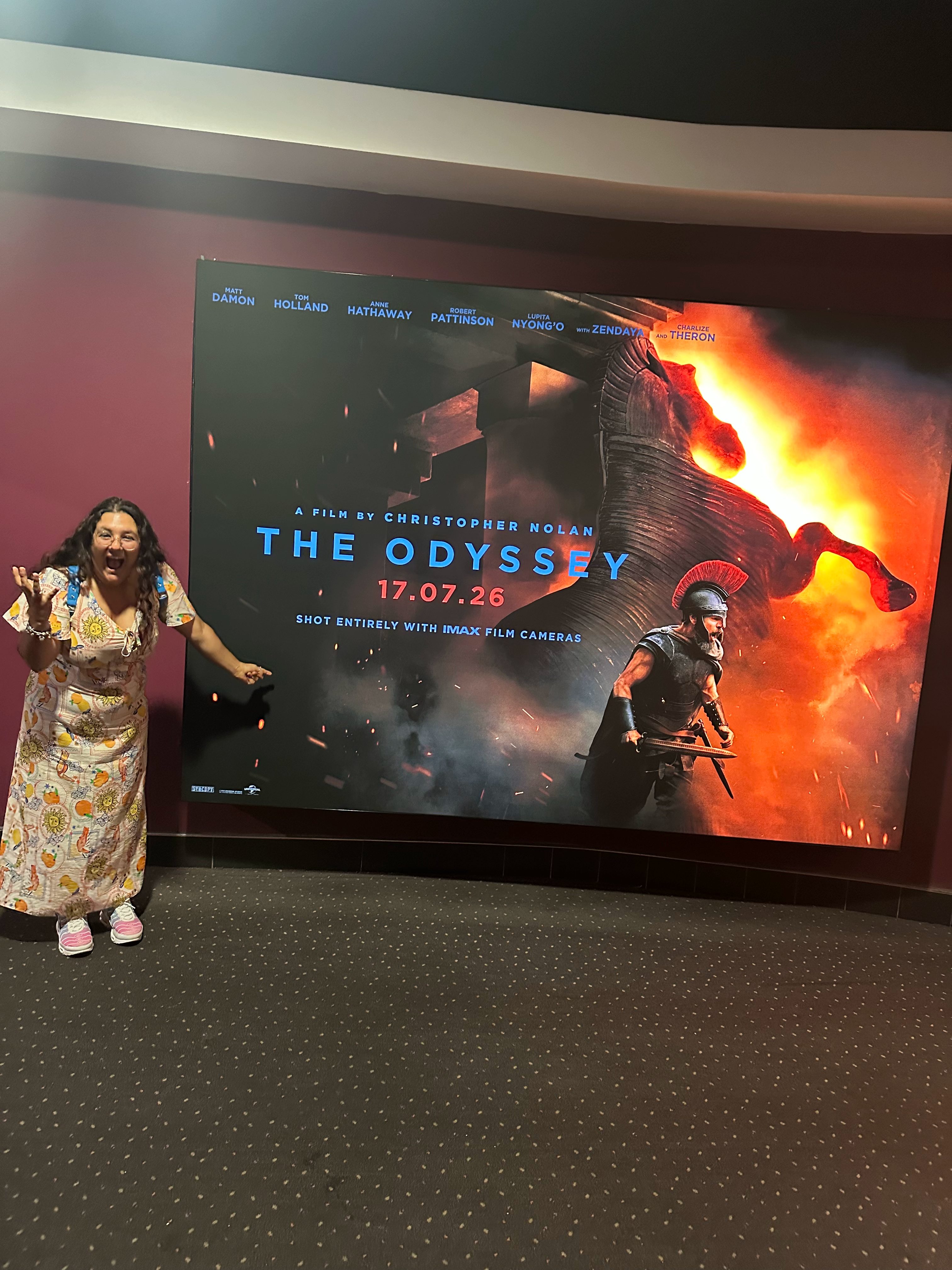

In short, the answer is yes. But of course, this is a review. So, here’s the long answer.
(Before I get too into this post, let me just say: Get yourself comfy, get a drink and snack – I had a lot of thoughts to share. I did warn you; I said here’s the long answer!)
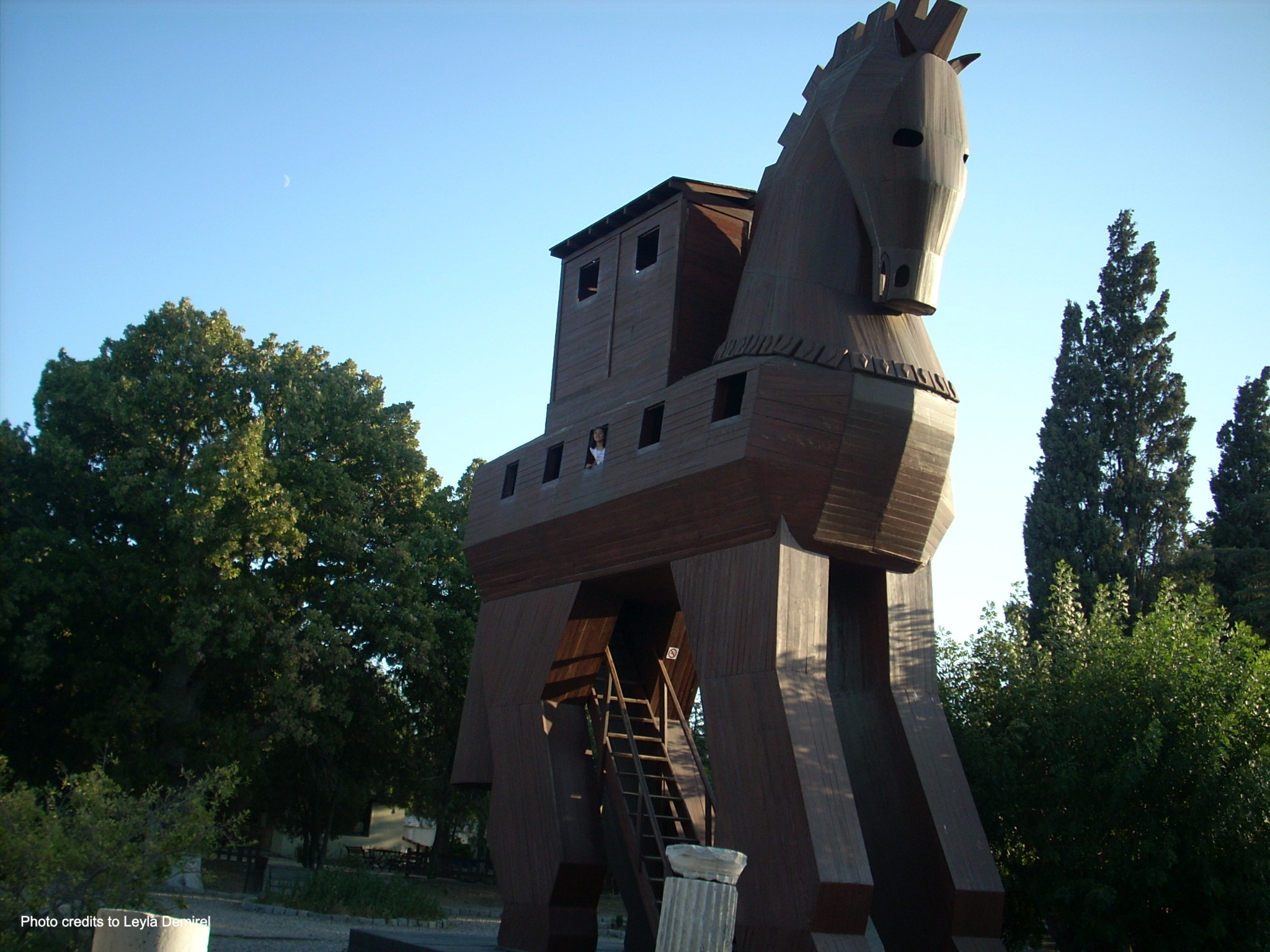
For context, I am an ancient history nerd through and through. I have been for as long as I can remember. When I was just twelve, I got ridiculously excited about seeing the Horse of Troy in the flesh in Türkiye. My dad brought me up with stories of the Greek gods and Roman emperors. I’ve grown up with and loved the Percy Jackson series, which only furthered my love of the original mythology, and I’ve studied the classics not only at college but independently. This is one special interest I’ve always had and never lost. So, needless to say, I was very excited and also very apprehensive about this movie.
But of course, this is Christopher Nolan, a world-famous and hugely celebrated filmmaker. If anyone was capable of taking on this mammoth story, it was him. And what a stellar job he did.
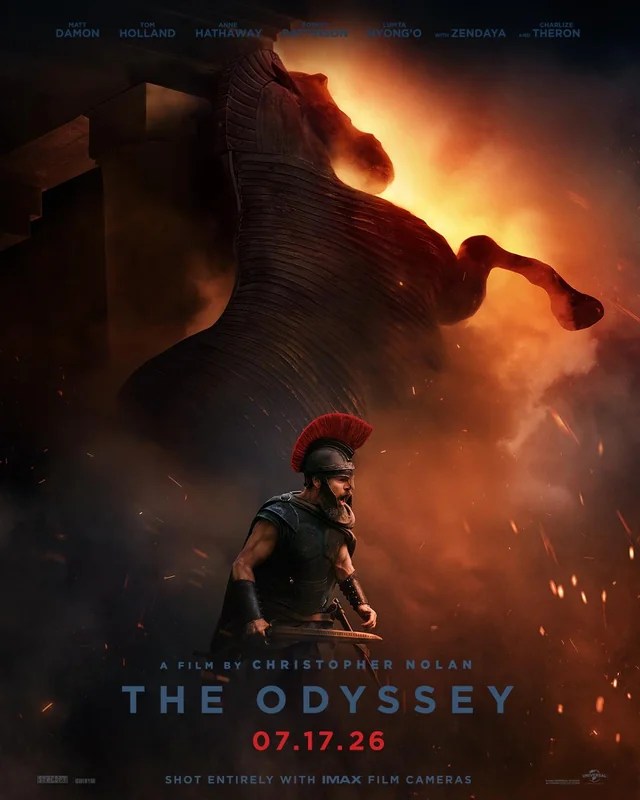
Film: The Odyssey
Director: Christopher Nolan
Producer: Emma Thomas & Christopher Nolan
Rating: ★★★★★
Release date: 17th July 2026 – out now!
Not only is Christopher Nolan at the helm, but The Odyssey has a phenomenal cast who give incredible performances the whole way through. Matt Damon as Odysseus is a masterclass in acting. Damon has expertly brought this iconic, complex man to life with so much depth and meticulousness. Damon shows Odysseus as the complicated man he is, displaying his desperation, quick and clever thinking, guilt and genuine trauma. His performance is heartbreaking in every sense of the word. Damon shows Odysseus’ character growth throughout the movie, with the emotions heightening with every step closer to home Odysseus gets.
Furthermore, whoever Damon, as Odysseus, comes into contact with is so interesting to watch. Be that from the intimate love that is palpable between him and Anne Hathaway as his devoted wife, Penelope, to the disquieting tension between Odysseus and Samantha Morton as Circe, all Damon’s onscreen relationships, regardless of whom or the context, are injected with great emotion.
The Odyssey starkly shows that Odysseus is not necessarily the hero or good man that everyone has put on a pedestal after the fall of Troy, but on the flip side, nor is he a villain, but somewhere in the middle. Damon has clearly understood this, and seeing Damon embed this characterisation into every aspect of his acting is remarkable. It is obvious in every second of this film that Odysseus is a role Damon has not taken on lightly. The nuance of Damon’s performance shows a great understanding of all aspects of Odysseus as a character, which Damon demonstrates adeptly. Odysseus is a huge role with such a heavy weight of expectation, yet in The Odyssey, Matt Damon deserves all the praise he is receiving, as he really does deliver the performance of a lifetime.
It is in The Odyssey that Tom Holland really shows what a skilled actor he is. If for some reason one did not see him as a serious actor before, after this film, there is no denying it anymore. Holland expertly displays a youthful Telemachus who is losing his naivety, feels the heavy weight of expectation and has a deep desire to do his mother, Ithaca and his father justice and make them proud. Whether intentional or not, the echoes between Damon’s Odysseus and Holland’s Telemachus were a beautiful detail, as Holland tries so hard to walk and live in the footsteps of a father he barely knows. Moreover, whilst they do not share a great deal of screen time, the love between Odysseus and Telemachus felt as palpable as the love between Telemachus and his mother…that is to say, the love felt deeply powerful. Holland pours such a vast range of emotions into every scene he is present in, with such genuineness and impact, it’s hard not to get swept up in these emotions with him. The hope, longing, love, anger and fear disguised behind Telemachus’ bravery that are all present in Holland’s portrayal as Odysseus’ son are clear markers of how talented an actor he really is.
Anne Hathaway’s Penelope is fantastic. Her heartbreak and the way she was torn between moving on and waiting was tangible, but even more than this, she brought out the calculated and intuitive side of Penelope with such precision. With her acting choices through every second she is on screen, Hathaway’s Penelope cleverly puts on different personas depending on which characters she’s interacting with – the Penelope who interacts with suitors as opposed to her trusted family or staff are two very different kinds of Penelope. From the softer, emotional sides of Penelope to the fiery, steadfast leader she’s been forced to become, Hathaway embodies all layers of Penelope with great effect.
Himesh Patel as Eurylochus was a brilliant supporting role. Patel found the exact balance between the man who wants to stand by Odysseus whilst also being the voice of reason. He advocates for all the men when Odysseus is blinded by desperation to go home, and we see Patel’s Eurylochus’ own desperation shine through and blind even himself at times in a way that’s heartbreaking and raw. Every element of screen time he has was skilfully performed to bring Eurylochus to life so impactfully. Occasionally, I even found myself watching Patel for his reactions in scenes more than Damon himself.
Zendaya as Athena was very clever. Without spoilers, her final appearance in the film makes her presence throughout the film until that point make even more sense, and that understanding is what makes her role even more poignant. Whilst she was not on screen a great deal, whenever Zendaya was present, it was a moment of heavy emotion, especially from Matt Damon. Adding a human face to the atrocities Odysseus has been a part of makes his journey and trauma as a consequence feel that much more haunting. Zendaya is a stellar choice of actor to take on this role, which she performed impeccably.
This is one film where, of course, Matt Damon deserves all the praise he is receiving, but it is nearly impossible to say who is the standout supporting role, as each and every member of the cast is equally impressive. This is not even just limited to the lead cast members, as there was never a moment where any one person took me out of the film. This goes without mentioning the great performances from Robert Pattinson as Antinous, John Leguizamo as Eumaeus, Samantha Morton as Circe, or Elliot Page as Sinon, who all also deserve praise. Every member of Odysseus ’ crew, the suitors, every extra, every person within this film completely embodied their roles.
One thing I do want to address about the casting is that a lot of people complained about the lack of Greek actors. Whilst this could have been a great opportunity for actors from Greece, Türkiye, Cyprus and more, realistically, I knew this would never be the case for the lead cast. Anyone who knows me knows I am as huge an advocate for accurate and diverse casting as the next person, but also that I am realistic. For as hyped a film as this, it was always going to be some of the biggest names in the industry that led the cast – and what a great job they did! But what I will say is the company of The Odyssey is very diverse. There may not be a Greek man playing Odysseus, but even the lead casting is diverse. When the crew, civilians, and all the extras who are in the film were on screen, it showed a very diverse cast. This is something that wouldn’t have been the case even ten years ago. So whilst it is maybe a missed chance, all things considered, I think the casting was carried out very well.
The Odyssey is a ten-year journey, which with this film has been made into a three-hour film. Three hours may seem long for a film, but watching The Odyssey was the quickest three hours of my life. The pace is maintained perfectly throughout with ebbs and flows of tension. Never for one second was I bored, from one obstacle to the next; everything had brilliant momentum, and the realism in every scene transported me to being right there with everyone. The most obvious example I can think of to give without spoilers (although the poem is thousands of years old) is the scene when the men are all hidden inside the horse, waiting to seize Troy. This scene was so tense and felt so real; my own heart was genuinely racing just watching it.
A large reason that every second of this film was so engrossing may be largely due to the way The Odyssey was filmed; it is visually stunning, every frame is of equal beauty, thanks to Hoyte Van Hoytema’s exquisite cinematography. Moreover, from watching interviews, everyone has said that Christopher Nolan wanted everything to be as real as possible and to use minimal CGI. So that scene when the men are in the horse, stacked in close together? They really were inside the horse, packed in – with Christopher Nolan with them, filming. The Trojan horse is a story that I, and so many others, know so well, but I’d never seen it told in such a way as this. The authentic filming is why the tension and excitement and such hit so hard. We aren’t watching people act in front of a green screen; they’re actually on location, and the way we watched it was as it was filmed. The decision to film and bring the story alive this way adds an extra layer to The Odyssey, immersing viewers right into the story. From the second the film started until the end, I was completely entranced.
The Cyclops scene was one which really took me by surprise. Nolan has directed this scene in a way that felt fresh. He presented this cyclops as, yes, something terrifying to Odysseus and his men, but also a cyclops that was just living peacefully alone until Odysseus disturbs this peace. The reaction when Odysseus attacks the cyclops was so interesting. I found this to be the first scene that really prompts audience members to question: is Odysseus good, bad, or somewhere in between? The sound in this scene was insane – in the literal sense of the word. The scream the cyclops lets out after Odysseus interferes (again, no spoilers. But, if you’ve watched, you’ll know *exactly* what I am referring to) was guttural, and cut straight through to my heart.
When watching, I marvelled at how real the cyclops looked. In a world of CGI and AI that can make certain elements stand out with how fake they look, this was a real contrast, as it looked so real. Having watched interviews and read behind-the-scenes material, there is a reason the cyclops scene looked and felt so real. The cyclops was actually a real sixty-foot puppet Christopher Nolan requested to be constructed for use in this scene. This is an excellent decision and goes back to that point I have made above. When there is that added level of realism, when what we are seeing is not fake – that is what brings the film and characters to life that much more.
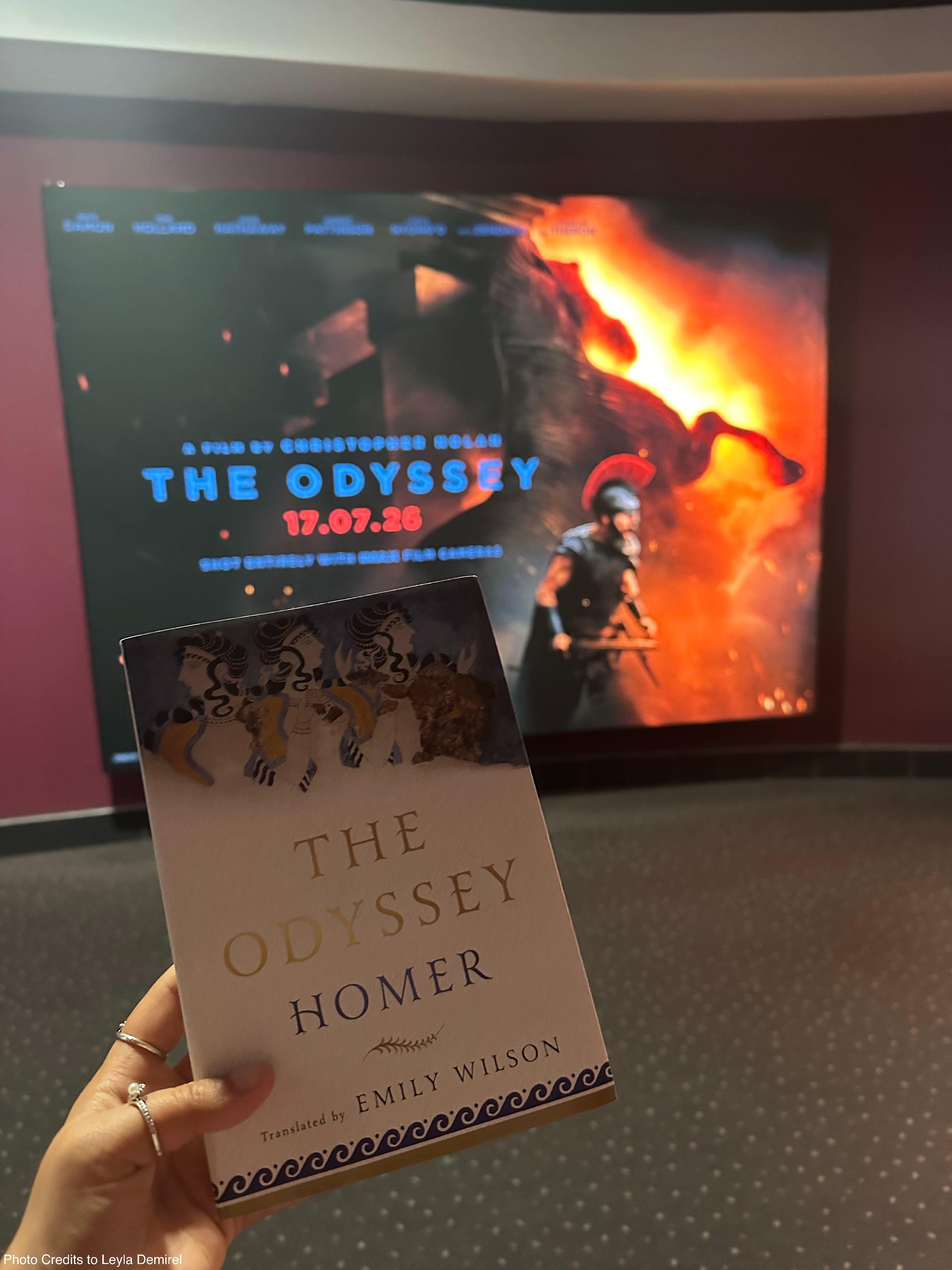
The Odyssey is a poem recounting a story, both of which are thousands of years old, yet the irony is that, despite the history, the story is still relevant. In fact, I’d argue that the story has never been more relevant – least of all because of the theme of opening our arms to strangers, like Zeus’ Law, as opposed to open hostility to strangers instead. The script throughout this whole film is poetic – there are so many lines that have stayed firmly in my head, so many beautiful and heart-hitting lines. What is clever is that, notwithstanding the poetic, immersive script, Nolan’s The Odyssey has been adapted in an easy-to-understand way. This version of The Odyssey has been made accessible to all, so however well you do or don’t know the story, myths, characters, etc., anyone can enjoy it.
As briefly mentioned above, regardless of the age of The Odyssey, there is still so much that people can identify with. The Odyssey displays the lengths people will go to when they want to get home, when emotions are fraught, and we reach breaking point, even when people are simply hungry – beyond hungry, starving and desperate for nutrition. What I also really loved in this adaptation is the exploration of the question that if one leaves home and returns a changed person – like Odysseus and his journey – is home really still home? The way Nolan delved into themes of home, identity and belonging within this film was fascinating.
Something else Nolan has put at the heart of The Odyssey is humanity. This film is not a whimsical story about a man going home who encounters pesky villains on the way. It is brutal, honest and raw – no element of this film is romanticised or glamorised. Nolan has shown in this film that this story is about great loss, where countless men with their own stories, hopes and dreams and lives to return home to…never get there because they are tragically killed. Nolan also shows that Odysseus and his men were not always good; they were not always the heroes they’re claimed to be. They were victorious over Troy, yes – but they also did wrong. They were human, which is why when we see them die across the film, it hits so much harder. Similarly, one of the particularly moving scenes (of which there are many) is when we see the battle at Troy at the end of the film. I won’t reveal why, but that scene was constructed in such a way that goodness me, the emotional impact really hit hard. Nolan knows how to put the human emotion and heart at the centre of his stories, and The Odyssey is a fine example of this.
There are plenty of adaptations of The Odyssey showing the lighter, fun perspective of this story, and as much as I love these versions (Epic the Musical, namely), I’d argue that Nolan’s dark and gritty adaptation is needed. also takes a skilled director to balance such darkness in a way that is respectful, yet again – this is something Nolan has perfectly executed. With The Odyssey, Nolan shows the reality of this story: after a severe and unforgiving war, a brutal and treacherous journey home – and home does not always mean the end and a happy ever after.
Every obstacle in The Odyssey is horrifying in the best way. Whether it’s the Cyclops or the Laestrygonians, the passage between Charybdis and Scylla or the trouble Odysseus has to manage back at Ithaca, from the moment this film starts, it really is one thing after another between Odysseus and his crew and getting home. One may think with the number of obstacles Odysseus encounters, the film may start to be predictable, but far from it. Each encounter is equal parts interesting and engrossing.
Circe’s island is one particularly horrific scene. Samantha Morton as the mysterious witch is superb. There’s an unsettling and eerie feeling to this scene with no definable reason initially, something Morton is brilliant with her delivery throughout. Furthermore, the transformation in this scene (no spoilers) is brutally visceral. It’s hard to watch, which only goes to show what a fantastically accomplished scene this is. Morton may only be in the film for this one short scene, but it’s a scene and performance that lingered in my mind for all the right reasons.
Now, of course, there are the opinions on historical accuracy. As I said at the start of this post, I love classics and have studied them avidly both in and out of an academic setting, but I’m far from being an expert…but to me, the costumes all looked like they fit perfectly and beautifully within the context. A detail I actually loved is how the costumes looked worn! These are not new pieces of armour the men have just donned; they’re at least ten years old. It is these small attentions to detail throughout this film that, however small, matter a lot. The costumes are not the only thing people have commented on. There have been comments on the cast – to which I refuse to add to the conversation and fuel dated opinions, and as you may have gathered from the start of this post, I think the cast were perfect. Again, similarly to what I have already mentioned, the accuracy can also never be truly known due to the number of translations The Odyssey has gone through, from oral to written to page and screen and more. Importantly, nothing looks out of place. To me, watching, the costumes felt authentic, the cast were all stars in their own right, and if we want to discuss realism and accuracy…are Cyclops real? Are sirens and witches that can turn people into pigs real? What I also think is important to remember is Christopher Nolan never set out to make a documentary. The Odyssey is an adaptation that is meant to tell a story that people can enjoy, and maybe even educate at the same time. The Odyssey does both of these very well.
The music in The Odyssey is breathtaking. It elevates every scene and is flawlessly constructed. From the haunting, eerie soundtrack for the Sirens to the resounding, dramatic drumbeats used for the battle in Troy and conflict back in Ithaca, Ludwig Göransson was the perfect choice of person to provide the music for this film. The instruments used were such an excellent decision – to not use an orchestra but to try and use ancient instruments to create music that echoes the time period? A stunning choice that more than pays off. Every piece of music throughout The Odyssey is so emotive and sublimely crafted.
Another comment which I have seen in regards to this film is that there are parts of the poem which have not been included. A couple of examples include that Odysseus spends a year on Circe’s island and that he mocks the Cyclops as they sail away. The Odyssey is a good four hundred and fifty to five hundred and fifty page poem, and as it is, this film is close to three hours long. When adapting such a lengthy piece for the screen, of course some parts will have to be cut out for the adaptation; otherwise we would have a six-hour film (which, to be fair, I would watch). Again, I’ve said above – there are countless adaptations that all show different versions of this story and these characters. The majority of the poem has been kept in, but for any adaptation of anything, ever – it will never be an exact carbon copy from page to screen. I personally think what Nolan has done with The Odyssey is nothing short of incredible.
When watching, whilst I noticed certain parts of the poem weren’t included, not once did this bother me or take away from how much I enjoyed every moment of the film. Some may call me a ‘fake fan’ for this, but by this point, I’m sure you can all gather what a big fan of classic history and mythology I am, and even I don’t have any critique to make, despite going in feeling very tentative.
There really is never a second in this film where the excitement lacks, or my attention waned. From the second The Odyssey started until long after it had finished, I was hooked and completely entranced by what I was watching.
The Odyssey is a huge moment for cinema and for storytelling. The attention to detail in this film is unfathomable, and that attention to detail combined with the realism and hard work really make a difference between a good film and a truly great one. The Odyssey shows how epic both cinema and storytelling can be. Neither is a dying art form, and The Odyssey is a true testament to that.
No matter how many words I use, no matter what I say, it will never be enough to do this epic film justice. The Odyssey is something to be experienced firsthand – ideally, in a cinema. Seeing this on the big screen felt so momentous and special, and I will never forget that insane feeling of watching it all for the first time. At this time of writing this, I have my third trip booked already, which I know is not going to be my last.
The Odyssey is not just a film; it’s an epic story told epically with a massive amount of work, love, dedication and passion poured into it – and it shows. The Odyssey is a film that will be celebrated and talked about for a long time for all the right reasons. This is not a phrase I use lightly, but The Odyssey deserves it – this film truly is a cinematic masterpiece.
One final note from me: if you made it all this way, a big thank you from me for reading my words all the way to the end. And if anyone wishes to chat to me about The Odyssey, please do so via my socials – I’d love to hear others’ opinions and discuss this film even more!
On that, enjoy these before and after photos of me…