

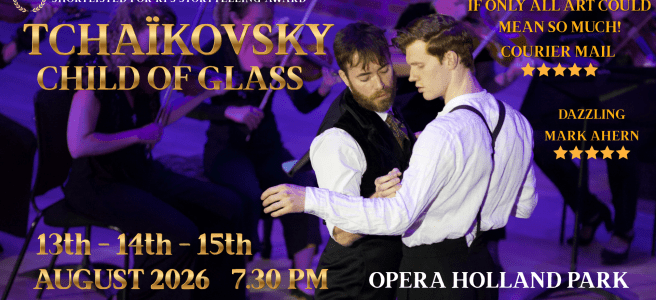
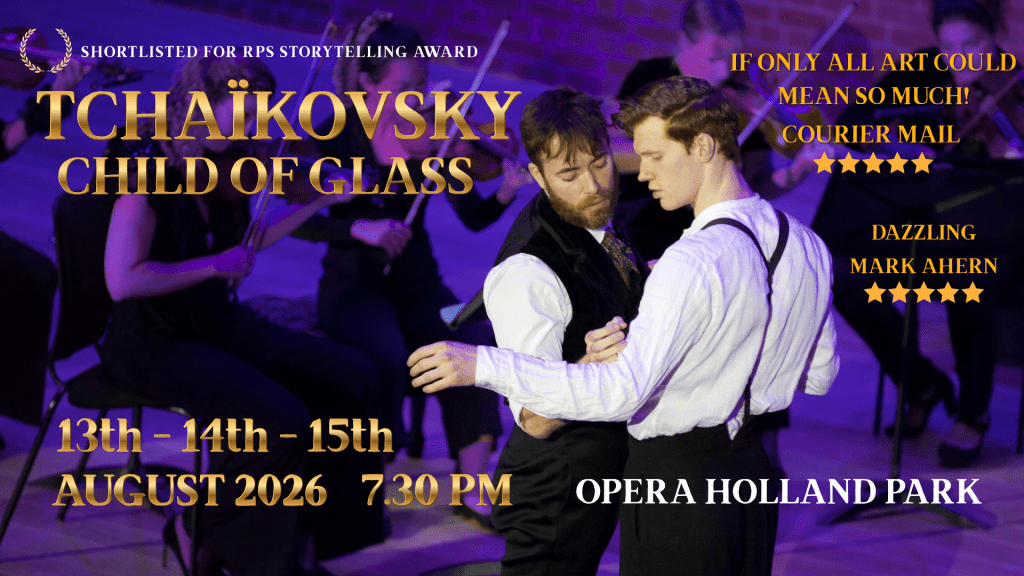
Child of Glass is a new genre-bending play, soon to hit the stage in its UK premiere, running at Opera Holland Park on the 13th-15th August. The show tells the life and gay loves of the iconic classical music composer Tchaikovsky, with the additional elements of music and dance. The dance is choreographed by a former Royal Ballet dancer, Stephen Wicks and performed by Royal Ballet’s Téo Dubreuil. The mix of art forms of the play, music and dance are all coming together to provide a brilliantly unique form of storytelling in Child of Glass.
I am lucky as I have been able to interview Tama Matheson, the very writer and performer of City of Glass, in the lead-up to the show hitting the stage.
The interview was fascinating and insightful. Matheson shared the inspiration for telling Tchaikovsky’s story in such a way, why Matheson thinks Tchaikovsky is still so relevant and loved, and why those who may not think this show is for them should come along to see it for themselves and be pleasantly surprised.
Without further ado, here is the interview – I hope you enjoy reading it as much as I enjoyed conducting it!
Note: None of these answers have been edited in any way, shape or form. They are exactly as they were sent to me.
Hi there, and thank you for doing this interview with me! Starting simple, can you please introduce yourself and tell us a little bit about what Child of Glass is?
I’m a writer, director, and actor from Australia (though born in London), and have worked, for many years, on both sides of the globe, in theatre, opera, and TV. I’ve been in London for about 8 years, now (though I lived here after studying in Oxford), and adore the teeming cultural life of this city. London has everything.
My chief love, as an artist, is the classics – in literature, in theatre, in music, and I find myself constantly fascinated by the great figures in our cultural history – the women and men whose genius helped to form our ambitions, thoughts, ideas. Coming from a musical-theatrical family – my parents both worked in the opera, and my brothers and sisters all work in either TV, theatre, or opera – and working as an opera director myself for many years, I grew up on classical music, great literature (which often underpins opera), and history; and I began to wonder, several years ago, whether one could create a powerful and highly dramatic way to tell the stories of the great artists that fuses music and drama into a new and exciting whole. The result is something quite extraordinary: a fresh genre of theatre-with-music that touches people viscerally. These music-plays are full plays, with a full concert of music knitted into them. But, where theatrical music tends to be a gentle soundscape in the background, in these plays, the music is some of the greatest, most powerful art ever written – so when it bursts out, it is truly overwhelming.
Child of Glass is a new genre-blending play with music and dance, which is probably not how a lot of people imagined the life and gay loves of the iconic composer, Tchaikovsky, would be told; what made you decide to tell his story this way?
I think the only way you can paint a full picture of a composer is to situate them within the milieu of their music – the music must flow in and out of their lives, illustrating it, and being illustrated by it. The play does defy classification by mixing art forms, and thus creating its own universe of storytelling – and, in that universe, theatre transforms into music, music transforms into dance, and all 3 art-forms combine to propel the story forward. And what a story it is! Tchaikovsky’s life is incredible. The reason for including dance was twofold: first, Tchaikovsky was absolutely instrumental (pardon the pun!) in lifting ballet out of the doldrums it was in (it had been plagued, until then, by mediocre music) to its eminence as a great art form; and, second, because Tchaikovsky lived in terror of being exposed and punished for his sexual proclivities (as Wilde was at the same time in England). And, as he lived this secret, hidden, inner life, I realised this could be powerfully expressed by externalising it – embodying it in the figure of a dancer. Our dancer, therefore (Teo Dubreuil from the Royal Ballet), becomes a kind of haunting alter-ego, who tempts and torments Tchaikovsky with the passions and desires of his own nature. This means I am able to make Tchaikovsky’s inward struggles hauntingly visible to the audience: ghostly, terrifying, beautiful.
Child of Glass is set to make its UK debut next month; what made you decide now was the time to show this play to the world?
We had a great success last year with my play about Beethoven “I Shall Hear in Heaven,” and, looking for piece for this year, I decided that Tchaikovsky would be ideal. Not only is he one of my favourite composers (I don’t believe there is any composer who pours his passion into his music as powerfully as Tchaikovsky does) but his life is also extremely topical: Tchaikovsky had to negotiate the strictures of an intolerant society – and found that he could do so most effectively by turning his passion into music. As such, his music is innately dramatic, and forms the perfect basis for drama. It’s also, in a curious way, everyone’s story, gay or not, because it is the tale of someone fighting repression and prejudice in order to be true to himself – to express his real humanity. It’s a truly universal tale. And now, of course, with all sorts of antiquated bigotries making their way back into the world’s consciousness, this story is all the more crucial to tell.
Tchaikovsky is an iconic composer whose work has reached all corners of the globe; why do you think that he and his music still stay as relevant and popular as ever?
Because his music is just so beautiful and so touching. He can never ceases to be popular or relevant, because his melodies are so infectious – but also so real and powerful – somehow they seem to express everything – everything challenging, anguishing, and triumphant – about being human. And I wonder: did he, perhaps, write the most well-known tunes of all? The Nutcracker (Sugarplum Fairy, Russian Dance, Pas de Deux); Sleeping Beauty (made all the more famous because of Disney’s 1959 film); the 1812 Overture; the Piano and Violin Concertos; Swan Lake. Everyone knows these works, whether they are classical music lovers or not. Tchaikovsky is just a part of world culture and consciousness: his melodies seem to have the power to speak to everyone, in all place and all eras. I think because they are so passionate and true.
Stereotypically, Tchaikovsky is not necessarily someone younger people with a limited knowledge of music would have an interest in. What would you say to convince them to come and see Child of Glass?
It’s hilarious from beginning to end, yet turns on a penny and makes you cry, then lifts you up to the zenith of excitement, and finally shatters with that anguish that uplifts the soul. In other words, it’s got everything – and, throughout it all, you get washes of that wondrous, wondrous music. It’s a show that will skip by, but sound the very depths of your heart. It may, also, be the greatest gay love-story ever told – and one of the greatest stories about fighting the system there has ever been. Added to that, you also get an evening of dance – so its visually stunning, musically dazzling, and viscerally dramatic. Come and have a picnic in Holland Park during the day, then come and see a glorious piece of theatre in the evening. And, if none of that rings for you, then bring someone to the show for a date: I can guarantee you’ll impress them!
Have you encountered any challenges during the creative process of putting this play together, from either a writing or performing point of view? If so, how did you overcome these challenges?
The main challenge with a subject as huge as this is always ‘how do I compress a whole life into 2 hours’ stage traffic? And how do we perform that life with just a few actors?’ Of course, these challenges are a blessing, because they force you to be creative, symbolic, poetic – which always yields something more powerful than the literal. To make 5 performers embody a whole world, and a whole life, is a thrilling challenge – and wonderful to watch, as you can see the magic of theatre unfolding before you. It’s the same challenge Shakespeare talks about in the Chorus of ‘Henry V’: “…can this cockpit hold/ The vasty fields of France; or may we cram/ Into this wooden O the very casques/ That did affright the air at Agincourt?” In our case, the question is, ‘can this quintet of performers paint the life of Russia in the late 19th century – the ballrooms, the palaces, the intrigues, the wonders – as well as the life of one of the greatest of all composers?” The other challenge, as ever, is trying to fill the theatre. This remains an eternal conundrum – how do you convince people to come along to a play they don’t know. Well, I can guarantee you an evening in the theatre such as you’ve never known!
In contrast to that, has there been a part of the creative process that has been particularly exciting?
The way the drama, music, and dance fuse together in this particular play is beyond thrilling. Watching the drama transfers itself into music, and then the music transform into dance – we’re all just agog in the rehearsal room. We never stop wanting to rehearse! We keep wanting to rehearse, so that these moments never have to stop – and each time we do them, they seem to gather more meaning. I hope the audience feels the same!
Have you learnt anything new about yourself as a consequence of writing and performing in this play? Or is there anything you will now take away from Child of Glass?
I learned that the dread and doubt one feels in starting a new play is perfectly natural. Tchaikovsky felt it himself with all his music (including his greatest masterpieces), so I suppose I needn’t feel too bad about it myself. And, like Tchaikvosky, you just have to trust your instincts.
Child of Glass is a show that sounds like it has a lot of depth and complicated emotions; what is it like being part of a show that must be so emotionally challenging at times? Is there anything you had to do to look after yourself whilst putting the show together?
For me, the emotion is the pleasure – the depth and complication of the drama is precisely what I relish writing and performing. To delve into all that is the most exciting thing in the world – however anguishing it is. And it is a huge play, with huge themes: it it thunders with emotion – but if you just surrender to that emotion, if you let the story and the music and the dance run through you, they carry you away. Those great emotions are deeply edifying and uplifting in the end. Indeed, the very purpose of theatre is to uplift the soul by harnessing and laying bare human emotion.
Is there anything you’re most intrigued or excited to see the audience’s reactions to?
I am most excited to see how they will respond to the element of dance – to the way ballet threads its way through the story, and carries it along. I saw, last year, how powerfully people responded to the combination of words and music – but with this added element, I think they’ll be overwhelmed. There are two moments of incredible power I can’t wait to see the audience react to (I shan’t spoil them here) – and then there’s our ending. It’s colossal, thrilling, cosmic, and utterly shattering – I can’t wait to see how audiences are affected by it!
Child of Glass is running for just three days at Opera Holland Park; what are your hopes for the play after this run?
Well, I hope it will go on to other places, and that it might sit for a season in some theatre. I’m delighted that ‘Beethoven: I Shall Hear in Heaven’ is going, next year, to America, Australia, Flanders, and around England, and I hope this piece goes even further. I think it could sit comfortably in any stage in the world, and I hope it can be taken up by other theatres and enjoy many, many productions. And then there’s always the idea of translating it to film…
Final question – what would you like audiences to take away from Child of Glass?
I’d like them to take away the idea that this story is an analogue of everyone’s story – that the particular circumstances of Tchaikovsky’s life are emblematic of the general circumstances of everybody’s life. These great artists are given their gifts, I believe, in order that they can take the experiences of ordinary life, and compress for us into something comprehensible, something graspable by our intellect. They allow us to hold life in our thoughts, and examine it – to see that the tribulations and challenges of existence are the substance of existence, they are necessary to it; and by seeing that, by simply allowing us to hold life in our thoughts, in makes life livable. This is the wonder of art.
Finally, I’d love people to understand that these great artists lived lives just like ours – with all the same frailties, obstacles, doubts, anxieties, failures, and triumphs – and that they are not different from us except in their ability express it. That, of course, is mystery of genius: how can come people convert the experiences of life into such dazzling expression? These canonical figures sit at the centre of our consciousness not because some academics have chosen them from the morass of art around them, but because they express, with concentrated refinement, what it is to be ourselves. They hold, as ‘twere, the mirror up to nature – they are the mirrors to us all.
What a truly poignant discussion! Child of Glass sounds like it will be a really special show, not only a brilliant piece of theatre, but also one that remains highly relevant today. The love and passion that has been poured into this show is obvious from Tama’s answers and I think audiences are in for a real treat. I am honestly really sad I can’t see it for myself, and can only hope to hear more news after this run has concluded!
Child of Glass will run at Opera Holland Park from 13th to 15th August. You can find out more and book tickets here: https://operahollandpark.com/productions/tchaikovsky-child-of-glass/


