


I was having a discussion with my friend the other day regarding the content I share on my blog. I like to be positive if I can, and I hope that is reflected in what I write. This is why I write about things I’ve loved or highly enjoyed, in whatever medium that may be – books, theatre, film, etc..However, my friend made the very true point that if I don’t enjoy something wholeheartedly, or even at all, or can critique it…that doesn’t make it bad, not at all! Everything is all about personal tastes and preferences and what I may or may not like, someone else may have a completely different opinion. That’s the way of life, and I think I even wrote this in my first ever blog post when I started this page up.
Being able to critique whatever I consume is a skill I have largely honed thanks to the reviews I previously wrote for Dress Circle Antics. I thought this was something I could do quite well before, but in hindsight I can see how much better I’ve gotten since I started writing reviews, and that’s a skill I hope I’ve kept up, and will continue to practice.
With all of that being said, I am today sharing a review for a book that I recently read, that I only have given a 3 star rating; considering I usually only post reviews on here for books I have adored and given 5 stars for, I want to get in the habit of sharing work that didn’t quite hit the mark for me, and explaining why that is. So, here is my latest 3 star read, The Architect’s Apprentice by Elif Shafak (spoiler free, of course).
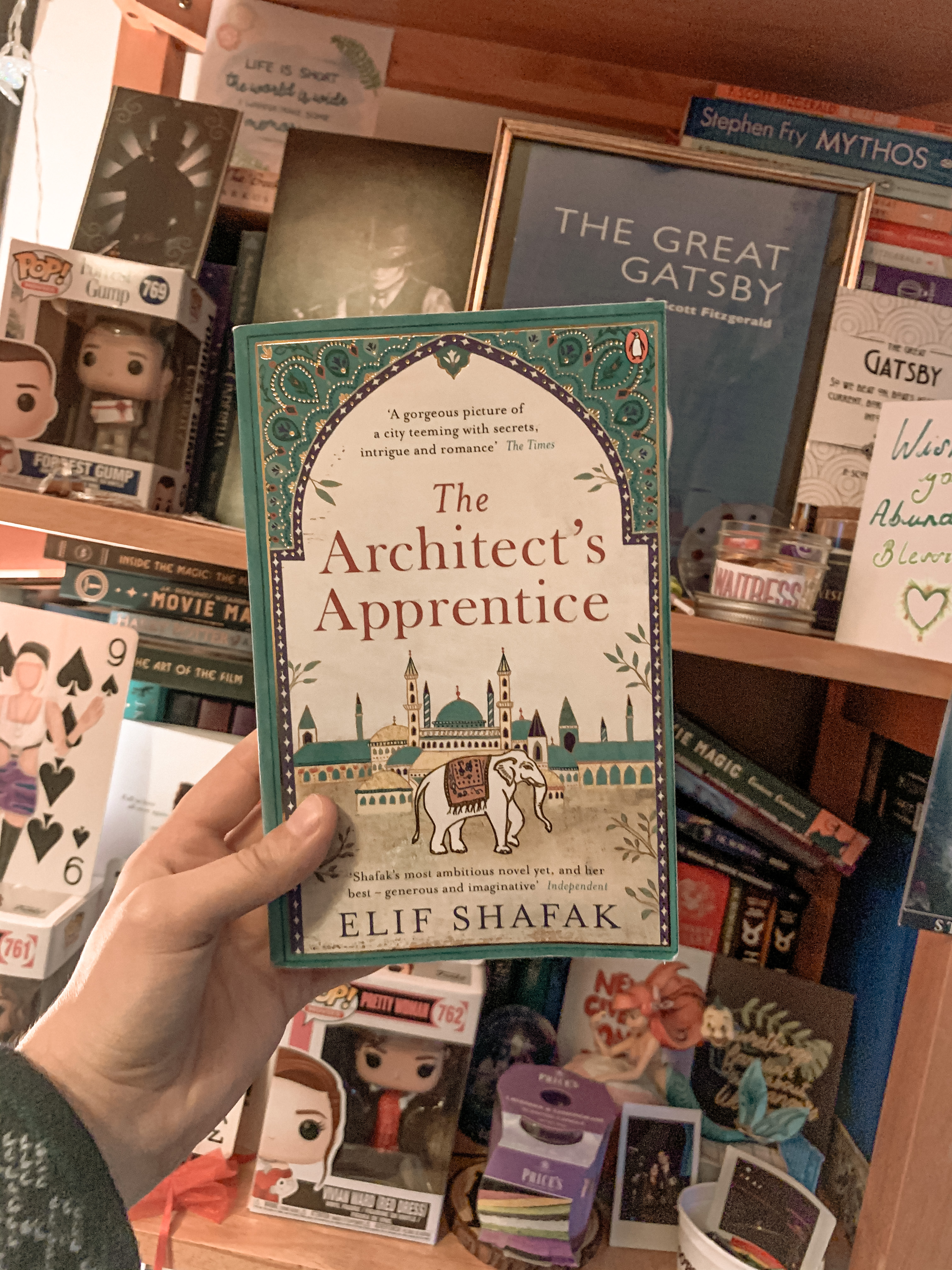
Book: The Architect’s Apprentice
Author: Elif Shafak
Year published: 2015
Genre: Historical fiction
Rating: 3 stars
As before with previous reviews I have done, I will share the description of this book as taken from goodreads:
“In 1540, twelve-year-old Jahan arrives in Istanbul. As an animal tamer in the sultan’s menagerie, he looks after the exceptionally smart elephant Chota and befriends (and falls for) the sultan’s beautiful daughter, Princess Mihrimah. A palace education leads Jahan to Mimar Sinan, the empire’s chief architect, who takes Jahan under his wing as they construct (with Chota’s help) some of the most magnificent buildings in history. Yet even as they build Sinan’s triumphant masterpieces—the incredible Suleymaniye and Selimiye mosques—dangerous undercurrents begin to emerge, with jealousy erupting among Sinan’s four apprentices.
A memorable story of artistic freedom, creativity, and the clash between science and fundamentalism, Shafak’s intricate novel brims with vibrant characters, intriguing adventure, and the lavish backdrop of the Ottoman court, where love and loyalty are no match for raw power.”
Despite me having only given this book a 3-star rating, I did enjoy it. It’s somewhat sad however, because I have read a few of Elif Shafak’s books previously and thoroughly enjoyed them. It just so happens to be that so far, I’m saddened to say that this is my least favourite book of hers I have read. But as I said – that’s not to say I didn’t enjoy the book.
The writing was beautiful and entrancing. Elif Shafak always writes about Turkey in such an honest and vivid way, and The Architects Apprentice is no exception to that. She has brought this historical era of Turkey completely to life in full technicolour with detailed descriptions of the sights, smells, sounds – everything, to really transport the reader. The characters she has written are fantastic; they are incredibly fascinating to read about and are written with so much depth to them and really blur the lines and make you think of what makes a person ‘good’ or ‘bad’ through their words and actions. In particular it was really interesting to see how such a range of characters all affect and interact with Jahan and his life.
This is very much a character book, following Jahan and the events of his life, as opposed to being a plot heavy book. I really enjoyed how throughout the book we go on a journey following Jahan, watching him grow from a child to a much older man, watching him learn, change and develop. I liked the multiple storylines that were explored; Jahan’s arrival in Istanbul with Chota and the threat of the Captain remaining to loom over him, Jahan’s complex emotions, including his conflicting feelings for Mirimah, and reading how Jahan learns to leave his resentment and past life behind, instead dedicating his life to working as an architect’s apprentice.
Having said this, the book had a few storylines that felt either too convenient – they were concluded almost far too easily so that they felt a bit flat…or alternatively, not all the loose ends were tied up. I understand in life you don’t always get neat endings, but a few stories that had either of these conclusions just didn’t sit right with me when reading. There is one storyline however that I want to bring particular attention to that I thoroughly enjoyed. About halfway through the book, and to the very end, there is a continuous storyline that is only tied up within the very last few chapters. Some very subtle hints and clues are dotted throughout the book, but it isn’t until the final conclusion that you realise how they all slot together and the story concludes. This one subplot in particular I found quite complex and clever and was my favourite plot to follow within the book.
It is also worth saying that this book is not an easy read. With the sheer amount of details – dates, names and places, you do have to concentrate when reading. Again, this is not something I have a problem with, and it shows how much time and work has gone into creating the book. However, the book was a slow read. I have no issue with slow-burn books – ‘The Book Thief’ and ‘The Night Circus’ are two of my favourite books and they’re both slow burners. But this book felt unnecessarily slow. There were passages and sections of the book that whilst being beautifully written, did not alter the story nor characters within the pages. There were sections that could have been taken out and the book would have not been affected. I would have read 100 pages and a lot of minor things would have happened, but at the same time – nothing had really happened at all, and it felt like we hadn’t really gone anywhere in the book, neither plot or character-wise.
Unfortunately near the end of the read, I was getting to the point where I was tired of this seemingly never-ending book. I found myself rushing to read it so I could read other things instead, which actually was quite upsetting, as I had such high hopes going in. For The Architects Apprentice, I’d say its a dead split 50/50 of my opinions on the book between the positives and negatives. I adored parts of it and did enjoy reading it; but it was a little too close to a Did Not Finish for me. Nonetheless I am glad I persevered made it to the end. Furthermore, I do still love Elif Shafak as an author and this hasn’t put me off reading more of her work. Overall, his was a heartwarming and enjoyable read, but I think this is a book you really need to commit to.

 One Show at a Time
2 thoughts on “A beautiful book, but a slow-burn read | The Architect’s Apprentice Book Review”