

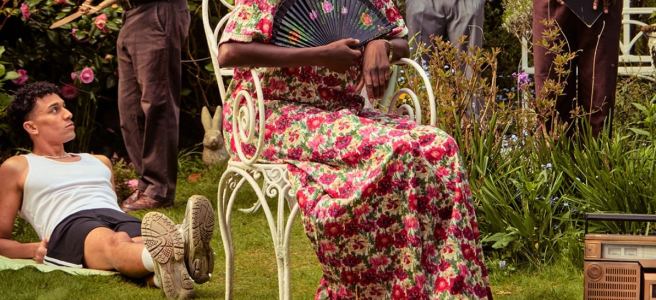
Bush Theatre is a venue known for showcasing stories that are not only hugely emotive but are also impactful and explore themes and issues being faced daily. Miss Myrtle’s Garden, currently making its world debut at London’s Bush Theatre, is no exception to this.

Show: Miss Myrtle’s Garden
Writer: Danny James King
Director: Taio Lawson
Theatre: Bush Theatre
Runs until: 12th July
Rating: ★★★★★
Note: I was kindly invited to attend this show, however, this review and my thoughts remain completely honest and are entirely my own.
Dementia is an illness that affects people daily, yet there is limited representation of this within theatre. Miss Myrtle’s Garden tells the story of one woman and her declining health as a consequence of dementia, and how it affects not only her, but her loved ones.
Whilst Miss Myrtle’s Garden is about dementia at face value, it is a multi-faceted play that delves into a lot of complexities that come with life. Thanks to Danny James-King’s beautiful writing and a cleverly crafted script, Miss Myrtle’s Garden is also about authenticity and being true to ourselves, loneliness and community, gardening and a bit of tea…and overall, love. In all its forms. And still so much more.
Diveen Henry as the titular character, Miss Myrtle, does a fantastic job – she rarely leaves the stage and commands attention at all times. Henry’s acting choices ensure that even when she is not speaking, Myrtle is a fascinating character to have lead the show. Henry subtly yet masterfully shows the two sides of her character; on the one hand, she is a very proud woman with both a sharp mind and tongue. On the other hand, there are signs of her deteriorating mental state that gradually increase as the play progresses. This development throughout the play is evidently done with sensitivity and respect, and is affecting to watch.
Michael Ahomka-Lindsay as Rudy, Myrtle’s grandson, is heartbreaking. He demonstrates the struggles of being pulled in many directions and trying to juggle everything all at once, whilst still keeping a degree of control and staying true to himself. Seeing his ever-increasing stress levels, frustration, and heartbreak at his grandmother’s declining health is a brutal yet honest and moving performance.
Henry and Ahomka-Lindsay’s on stage relationship is endearing. There is a real feeling of tenderness on both sides, and it can never be doubted for a second how much they both care for one another.
Myrtle and Melrose, her husband – played by Mensah Bediako – and Myrtle and Eddie, her friend – portrayed by Gary Lilburn – also have interesting dynamics to witness. Regardless of who Myrtle is presently sharing the stage with, there is amiability between her and her counterparts. Bediako and Henry may not share too many scenes together, but those they do are affectionate and sentimental. The love felt between the two would make it a challenge for even the hardest heart to not be moved.
Lilburn’s Eddie is a delightful character who is fascinating to learn more about throughout the play. He is almost a polar opposite to Henry’s Myrtle, but that only makes their scenes together that much more charming to watch. The pair’s acting choices show that although they may seem to irritate each other, their friendship is something meaningful to both of them. Lilburn, in particular, delicately portrays the loneliness Eddie is experiencing and how Eddie and Myrtle’s companionship is something precious as it combats this isolation for them both.
Completing the company is Elander Moore as Jason, Rudy’s partner. The complete opposite of Rudy, Jason is a charming character who, all of a sudden, finds himself entangled in Miss Myrtle’s life. Moore and Ahomka-Lindsay skilfully display the difficulties that come with having to hide elements of themselves and the pressure that can add to a relationship. Moore’s touching empathy for Myrtle is sweet, but moreover, the discussions from Jason regarding the difficulties of hiding parts of himself felt not relevant only to his character, but something everyone can relate to in one way or another.
The company may be small, but they tell the story beautifully, and they all work well together. The warmth and love of the company is obvious throughout the whole show, and this only makes the emotions hit that much harder.
Under Taio Lawson’s direction, the show is staged in the round. No matter where one is sitting, everyone has a clear view of what is happening. This choice also brought a real feel of intimacy to the piece, making it that much more impactful. No matter where someone is, they’re still close to a character and given how high the emotions run throughout the show, the tension is perfectly palpable.
Whilst Miss Myrtle’s Garden is somewhat heavy with the themes of dementia, homophobia, grief and more, the script is well written. There is both emotion and humour interwoven to keep the show balanced. The play also jumps around chronologically, between the present and the past. This is carried out in a way that is still logical and makes sense to watch, but therefore reflects Miss Myrtle’s deteriorating mental state. The time jumps serve as a meaningful reminder that whilst the past shapes us and it’s important to remember and reflect, it’s also important to keep living in the present day and enjoy life too. There are unanswered questions at the end of the show, which do not feel frustrating, but rather like we are having a small insight into this family’s life.
The use of sound and lighting, courtesy of Dan Balfour and Joshua Gadsby, also aids with this reflection of the turbulent nature of Miss Myrtle’s mind. At times, the lighting and sound build in intensity to mirror the current scene, and whilst it may feel a lot to watch and experience, it’s brilliantly effective and a clever way to really immerse audiences.
It is shows like Miss Myrtle’s Garden that serve as a reminder of what an important and necessary art form theatre is. Theatre can help us escape, yes, but it can also tell powerful stories and raise awareness; more than that, it can also bring comfort in the knowledge that no one is ever alone. One can only imagine how it could feel for someone to watch this show and see someone else going through what they are, and the validation that could bring.
This may be the first time Miss Myrtle’s Garden is being performed, but we can only hope that after this run, there is a future for the show. With a beautiful script, a brilliant cast and a heart-wrenching story, Miss Myrtle’s Garden is a powerfully emotional, sensitive, honest and poignant piece of theatre.
Miss Myrtle’s Garden runs at Bush Theatre, London until the 12th July.
You can find out more and buy tickets here: https://www.bushtheatre.co.uk/event/miss-myrtles-garden/
Note: Please do check the trigger warnings for the show; these can be found on the website.

 One Show at a Time