
UnTethered is a one-woman, autobiographical play that has been played in DasDas in Istanbul, Turkey, Thespis Theatre in Queens, NY as well as The Tank NYC in Manhattan, and is now gearing up to make its debut here in the UK!
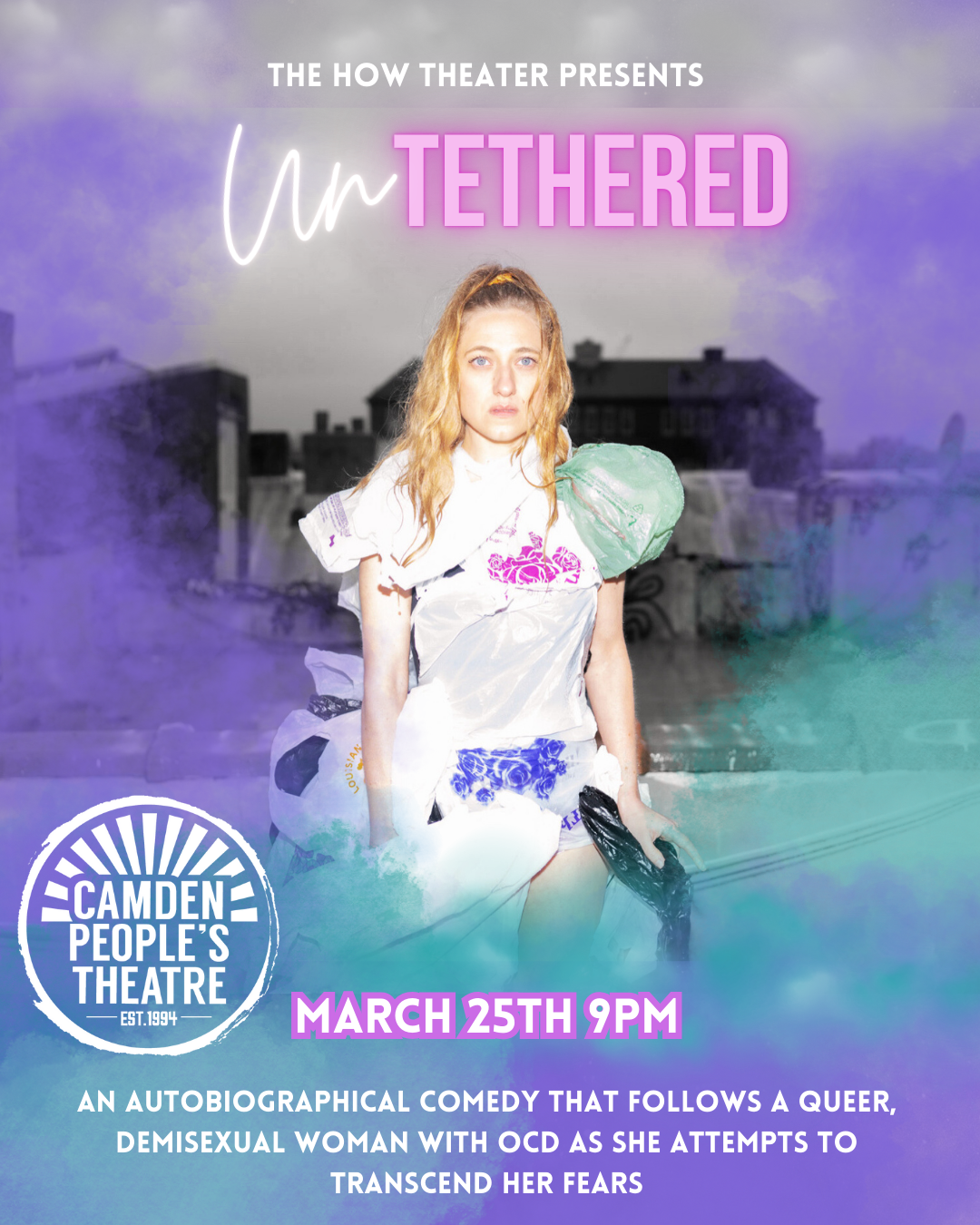
Running for one night only on March 25th at Camden People’s Theatre, UnTethered is a play about Obsessive Compulsive Disorder (OCD), Demisexuality and Queerness. Autobiographical and comedic, UnTethered follows a queer, demisexual woman with OCD as she attempts to transcend her irrational fears so that she may finally experience what it’s like to feel safe and loved. When her intrusive thoughts manifest as monsters made from plastic bags, she begins to question the absurd lengths the mind will go through to create an illusion of safety. UnTethered pushes at the boundaries of fixed identity and asks if we should tether to the things that make us feel safe, or if the power lies in the letting go.
I got the chance to interview actor, theatre maker and writer Tana Sirois about UnTethered, performing it in different countries, and what she hopes audiences will take away from the show. Here is what they said…
Starting simple – can you tell us what UnTethered is about?
UnTethered is about Obsessive Compulsive Disorder, and the impact it can have on relationships and intimacy. Ultimately, it’s a story about acceptance of the self.
What were your inspirations and motivations for writing UnTethered?
I wanted to reduce the stigma and shame surrounding OCD, mental illness and diagnosis. I wanted to better understand myself. I wanted to talk about the beautiful orientation of demisexuality, and open up people’s minds to the many different avenues towards intimacy and love. I wanted to embrace the concept of fluidity in identity, and celebrate the concept of an ever-changing self.
UnTethered feels like a very personal and sensitive show and story – what is the experience you’ve had writing and performing this autobiographical play?
It has been equally challenging and rewarding. I must admit there has been a considerable amount of self-doubt verging on self-hatred in the creative process, but in a strange way, these feelings have confirmed that I am on the right path. I wanted to make a show that was honest and vulnerable — one that accurately portrayed my experience of OCD. In order to do that, I needed to be willing to really break myself open and spend time with what’s inside. I’ve always approached heavy topics through comedy, so it made sense to view this story through a comedic lens. To be honest, OCD does feel comedic to me at times in that it reaches such high levels of absurdity. One moment, I am fully wrapped up in a spiral of fear, sure that death is imminent, and then suddenly, the wave of terror subsides, my perspective shifts, and the catastrophic event that I was bracing for just moments ago feels extremely unlikely. (Until the next catastrophic fear hits and the cycle begins again.) In my experience, OCD really does contain elements of exaggeration, incongruity and repetition, which are all standard ingredients in comedy, as well.
There have been a few theatre shows portraying mental illness and LGBTQ+ stories and characters in the past such as Next to Normal and Everybody’s Talking About Jamie, but there has been little to no representation of OCD and demisexuality in the media overall. Did this influence you when writing this show and bringing it to the stage?
Yes, in such a big way! When I was diagnosed with OCD I was shocked. My symptoms didn’t match the media portrayals of OCD at all. I am not a quirky, socially awkward yet brilliant detective or novelist, and I am not overly concerned with cleanliness or organization. We tend to hear a lot about the compulsive behaviour associated with OCD, but we don’t hear much about the mental torture of the obsessions that drive the compulsions. (We might see someone turning a light switch on and off 7 times and think it’s quirky behaviour, but we don’t know that this compulsion is driven by an obsessive thought that someone they love will die if they don’t.)
Something UnTethered touches on is identity and whether identity can make us feel safe or if there is power in letting go; can you tell us a bit more about that?
Claiming an identity can be so powerful. Grasping the inner workings of OCD really helped me understand myself. It allowed me to gain some distance from my fears and view them as a set of symptoms. Discovering and claiming the label of demisexuality was also extremely helpful because it provided a shorthand for the way I experience attraction. Instead of explaining to a date that I won’t really know if I’m attracted to them until we spend time together, share meaningful experiences, and develop an emotional bond, I can just say that I identify as demisexual, and if they’re interested in me, they can google it! Having a common vocabulary can be very helpful. However, I will say that there are times when I’ve felt constrained by labels. Sometimes, weeks go by and I don’t feel like I have OCD at all, and occasionally, I surprise myself by feeling incredibly attracted to someone I barely know. Labels are excellent as long as they continue to be helpful, but I find it can also be extremely liberating to toss them out the window. So much of life exists on a spectrum, and there is a real freedom in fluidity — in the process of allowing yourself to change.
What was your process like for putting this show together; what came first – the themes, the story, or was there a different process altogether?
The name came first. For as long as I can remember, I’ve been terrified of feeling out of control. When I am in the throes of anxiety, I feel unmoored — it’s as if the rope or cable that was linking me to a sense of security and safety has snapped under accumulative tension, and I am in a continuous state of free-fall. This image has been recurrent throughout my life, so when I was tasked with writing a 15-minute autobiographical solo performance as part of my MSc in Creative Arts & Mental Health, I decided to focus on my recent OCD diagnosis and how it finally explained this overwhelming fear of being out of control — of being untethered. (Can we stay tethered to something forever? What things should we tether to? Is it possible to live an expansive life while being tethered? Is the real goal to learn how to feel safe while being untethered?) The piece evolved into a full-length show from there.
I’m a collaborator at heart so the process of making this piece on my own was quite challenging. It was a massive relief when Polina Ionina finally came on board as director. I’ve worked with Polina before, and I trust her immensely. Autobiographical work requires a very special type of director — it needs someone extremely patient and precise. Polina pushed me in the best possible way. She really helped me expand the physicality of the piece and enhance the truth of my performance.
UnTethered has been performed in Turkey, America and is now coming to the UK; what is the process like putting on a show in 3 different countries – did anything need adapting or changing, or do you approach putting it on in every location in pretty much the same way?
It’s been a completely different experience in each country. The show has changed a lot! In Istanbul, we really wanted to make sure that the narrative and nuance would translate to an audience that most likely did not speak English as a first language, so we used subtitles for a large portion of the show and tried to make it as movement driven as possible.
When we went to NYC, we dialed up the audience interaction because we assumed a New York audience would be quite happy to get up on stage and play along (and we were right)!
I’ve done a big rewrite in preparation for the London show with the aim of enhancing the narrative of my experience with OCD, which looks something like: denial, avoidance, fighting tooth and nail, reaching a breaking point of utter exhaustion, and ultimately, arriving at acceptance.
What would you say to convince people to come and see the show?
This is the hardest question you’ve asked yet! It is so incredibly difficult to promote your own work, especially when it’s a story about your life. I suppose I would promise them that they will not be bored 🙂
This show is a bit of a wild ride in that it incorporates movement theatre, audience participation, puppetry, music, heightened text and improvisation. It’s very important to me that UnTethered is fun and accessible to audience members who don’t particularly relate to the experience of queerness, demisexuality or OCD, as well.
What do you want audiences to take away from UnTethered?
It has always been my hope that the people who see UnTethered walk away with a deeper understanding of OCD, and a heightened appreciation for the unique way we each experience love and intimacy. I did not see any realistic examples of OCD or demisexuality when I was in my 20s, and I really think my life would have been so much easier if I had. I would have felt much less alone. So, overall, I hope audiences feel seen, and I hope they walk away feeling inspired to show up in the world exactly as they are.
Lastly – can you describe or sum up UnTethered in 3 words?
Honest. Dynamic. Brave.
With all this being said, it sounds like UnTethered is going to be a remarkable piece of theatre, more than worth seeing. With a focus on sensitive and vulnerable themes and combining the play to be both emotional and comedic, UnTethered seems set to be something unique and compelling.
To see the hard work Tana Sirois has put into this show, and to see the outcome and finished piece, you’ll have to get yourself to Camden People’s Theatre on Tuesday 25th March at 9pm.
You can buy tickets for UnTethered here: https://cptheatre.co.uk/whatson/UnTethered
You can find out more about UnTethered and Tana Sirois here: https://www.tanasirois.com/untethered

 One Show at a Time