


No Funeral For Nazia is a book that captured my attention from the premise alone…Nazia not wanting a funeral but a party? And a surprise guest, bringing with them the promise that secrets will be revealed? What an intriguing premise for a book, and that’s without even opening it yet! Ironically, I’d already pre-ordered this book before I was offered a chance to read and review it for Neem Tree Press, so you can imagine how excited I was when this opportunity arose! Even more exciting is that I also got the lucky chance to ask author Taha Kehar some questions about this book; so without further ado – here is what I thought on the book, and read to the end to read the questions and have a read into the background of Kehar’s writing!
Disclaimer: Whilst I was sent a free copy of this book to read & review, my thoughts are not in any way influenced by this and all thoughts and opinions in this review are entirely my own.
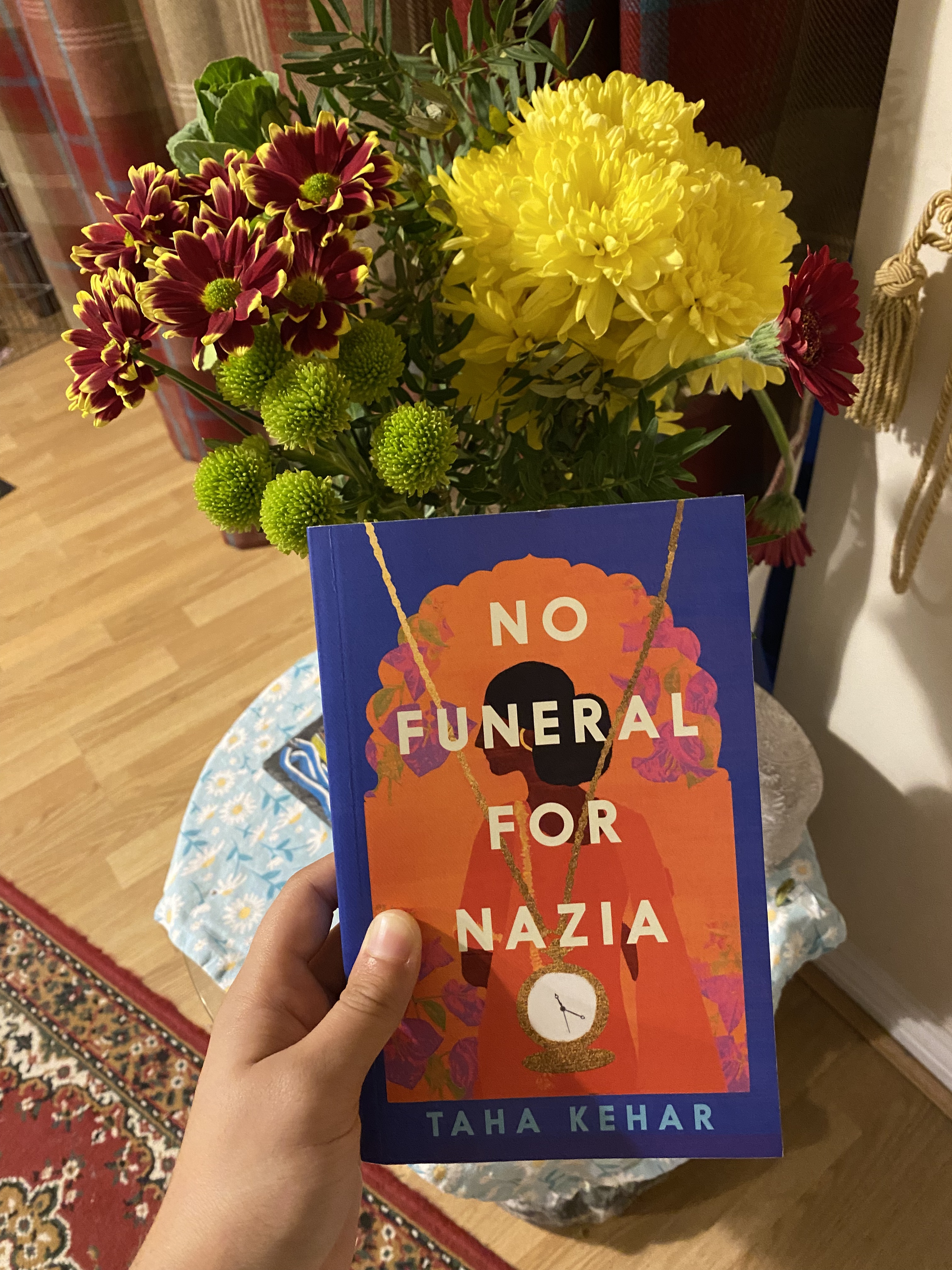
(AD/PR Product. Gifted Book for free book review).
Book: No Funeral for Nazia
Author: Taha Kehar
Genre: Literary Fiction
Rating: 4 Stars
Release date: 19 October 2023 (Out now!)
Synopsis taken from Goodreads:
“Nazia Sami is a celebrated author, but perhaps her greatest plot twist is yet to be produced. In her final days, she wields a pen one last time as she fills her diary with instructions for her sister, Naureen, and writes six letters to be delivered after her death. There is to be no funeral for Nazia. Instead, only six invitees are asked to attend a party, one of whom is a mystery guest. Over the course of an extraordinary evening, secrets are revealed, pasts reconsidered, and lives are forever changed. Perfect for fans of MOHSIN HAMID and KAMILA SHAMSIE, No Funeral for Nazia is a striking and inventive exploration of what death can mean for both the deceased and those left behind.”
I found this book a really thought-provoking and intriguing way to look at life, death, and how we view those we have lost both when they are alive and when they are gone, as well as how we mourn. Although this book is relatively short, it is a clever exploration of these themes, of grief as a whole, and how it affects everyone differently.
Something I think is really effectively done in this book is how the main character, Nazia, is dead. We learn that on the first page and it never changes. Yet she is so noticeably present throughout the whole book, in everyone’s thoughts, actions and motivations. Having a character feel so present despite them never being at the heart of the present-day action is no small feat but one that has been accomplished in No Funeral for Nazia in a compelling manner.
Within the book, Kehar has created a vast range of characters we are introduced to, and are really interesting to read about. They are all starkly different and as the book progresses, it’s really fun to dig a bit deeper into each of them and learn more about each individual. With a relatively large cast of characters present at one party, it’s quite impressive that each character is distinctive in their own right, and no one is lost amongst the others or forgotten within the pages.
I also love how with this cast of characters, whilst they’re all very different, they all have one connection: some form of relationship with Nazia. This is a concept I thought was brilliantly carried out and one of my favourite elements of the book; reading the different relationships between the characters and Nazia, and how one character’s relationship with her can actually affect another’s relationship with the same person! I’d have thought it would be confusing to write characters and relationships that overlap so much, but on the contrary, it was very easy to read and understand – and very enjoyable to do so!
It’s not often I read a book where I find the majority of the cast of characters unlikeable, but when I do – I love it! There’s something so real and raw about the characters Kehar has brought to life and I loved reading about them and being amazed at their words and behaviours when they’ve all been brought together by a melancholy reason. I personally love characters who aren’t wholly likeable or morally grey or whatever your preferred choice of words are. It makes them more real and certainly more interesting to read about! And as I said earlier, the more you read and learn about them, the more their behaviours and their personalities that we see at the party make sense.
Whilst I think this book is consistently paced, even more so given that it’s not particularly long, there is a distinct turning point in the book that I noticed a definitive shift in both the tone and the behaviors of the characters. It is at this point where the latter half of the book I feel moves faster and we learn a lot more about Nazia and the people mourning her in a really unexpected, unconventional and definitely interesting way. Kehar has certainly written a book that only gets more intriguing as time goes on; furthermore, whilst the book does cover themes with a lot of depth, there is a good balance written with the inclusion of comedic elements peppered throughout do aid in ensuring it’s not just a constant heavy read, and does bring the lighter tones when needed.
A gem of a book that really took me by surprise, No Funeral For Nazia is a deep book which is intriguing, thought-provoking and manages to be mournful yet not overly bleak. This book covers some really rather complex themes in a fresh, entertaining, creative and impactful way. It’s a book on life, death, love, loss, grief and the loved ones in one’s life. It brings the question: how do you want to be mourned? And more importantly, how do you want to be remembered?
Now, having shared why I think this book is so remarkable, it is time for me to share with you the interview portion of this post. I was very lucky to be able to ask author Taha Kehar some questions, and the answers he provided are really fascinating and compelling. I hope you enjoy reading them as much as I did.
How did the idea for this book first come about? What was your inspiration behind it?
I wanted to create a protagonist who existed as an ‘absence’ in the novel, but continued to have a strong influence on the narrative. The story of this protagonist would emerge through what her friends and family remembered about her. Daphne du Maurier’s Rebecca proved to be a useful guide in this regard.
What can people expect from this book?
An enigmatic narrative where women assume centre-stage and healing from past trauma is an important rite of passage.
Was there one part that was the most fun and the most difficult to write?
While I was halfway through writing the novel, I noticed that the characters had developed a voice of their own and were suppressing the narrator’s voice. It was difficult for me to accept this, but I eventually surrendered to my characters’ will. Once I did that, the story took on a life of its own and became more interesting to me.
Are there any parts and/or characters you’re most excited/intrigued to hear readers’ reactions and opinions on?
Nazia’s unconventional choice to disregard the accepted rituals of death and demand a party to celebrate her life will probably leave people full of questions. I’m also interested to see what people will make of her unexpected plans for the party, and how they’ll react to her mystery guest.
Do you put/see parts of yourself in your characters or when you write, are they completely separate to you, and therefore is it more fun to write people so different to you and see what journey they take you on?
I’m drawn towards certain characters because they’re vastly different from me. I feel the burning desire to get to know them and understand their motivation. At some point, a fragment of my personality spills into them – be it a quirk, an annoying habit or a distinct manner of speaking. While my characters eventually become spiritual extensions of me, they have the courage to do things that I probably wouldn’t dare to do. That’s what keeps me interested in them. Writing about oneself can become somewhat self-indulgent.
Do you plot/outline your books or just see the direction everyone takes you as you’re writing?
Outlines can be restrictive. I prefer if a story takes its own course. However, there have to be some checks and balances. With No Funeral for Nazia, I took breaks after writing each successive chapter to ensure that the story seemed cohesive and logical.
What is something you want your readers to take away from reading this?
Every story comes with different versions and narratives. We can choose to accept or reject them, but they carry their own cadence of truth.
How would you want to convince people to read this book in one sentence?
This isn’t just any party – it’s the party of a lifetime.
And if that hasn’t all sold you into giving this book a read..I don’t know what will!
No Funeral For Nazia is, at the time this blog post goes out, now available to buy and read! You can buy the book here: https://neemtreepress.com/book/no-funeral-for-nazia/
Thank you so much to Neem Tree Press for giving me the chance to read and review this book, and thank you to Taha Kehar for responding to my questions with such brilliant answers!
You can find out more about author Taha Kehar here: https://www.tahakehar.com/

 One Show at a Time